
Stress Management Therapy
- CBT Center
- > Stress Management Therapy
Stress Management Therapy in New Jersey, New York, and Online
Most people don’t come in saying, “I need stress management.”
They say things like:
“I’m tired of being tired.”
“I feel stuck. Like I’m painted into a corner.”
“I’m not sleeping.”
“I don’t know what to do anymore.”
And it’s usually not just one thing. It’s work. Home. Relationships. The constant sense that everything needs something from you, all at once.
What Is Stress?
Stress, at its core, is the feeling that there’s too much coming at you and not enough resources to handle it.
Not enough time. Not enough energy. Not enough support. Not enough space to think.
Stress becomes a problem when that overwhelm starts to outpace your ability to cope. Sometimes that’s because you don’t have the right tools yet. Sometimes it’s because you do have them, but they’ve gotten buried or worn down over time.
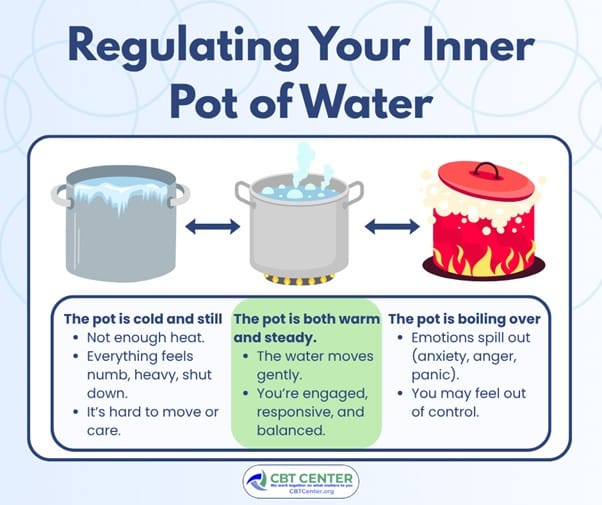
Think of it like a pot of water on the stove.
A little heat is manageable. You adjust, you stir, you keep things moving. But when the heat keeps building and nothing changes, eventually the water starts to boil over.
That’s when stress stops being something you’re handling and starts handling you.
What Stress Can Look Like
Stress shows up differently for everyone. For some people it’s mostly mental: the racing thoughts, the inability to shut off, the constant low-grade worry that something is being forgotten or dropped.
For others it shows up in the body. Tension headaches. Tight shoulders. A stomach that’s always a little off. Trouble falling asleep, or waking at 3am with your mind already running.
And for a lot of people, it shows up in behavior. Snapping at people you love. Avoiding things you know you need to handle. Reaching for food, alcohol, or your phone just to get a few minutes of relief.
Chronic stress can also look like:
- Exhaustion that sleep does not fix
- Difficulty concentrating or making decisions
- Feeling emotionally flat or numb
- Losing interest in things that used to matter
- A nagging sense that you are just going through the motions
If any of that sounds familiar, you’re not imagining it. And you’re not alone.
Our Expertise in Stress and Cognitive Behavioral Therapy
The CBT Center was founded by Dr. Michelle Drapkin, a licensed psychologist with specialized training in Cognitive Behavioral Therapy. Dr. Drapkin and Dr. Andrew Keenan are both board-certified in Cognitive Behavioral Therapy through the American Board of Professional Psychology (ABPP), the oldest and most rigorous board certification body in psychology, founded in 1947. ABPP certification requires credentials review, peer-reviewed practice samples, and a formal oral examination. It is not a certificate course. It is a peer-verified demonstration of advanced clinical competence in the specialty.
Dr. Drapkin and Jamie Schwartz are also Diplomates of the Academy of Cognitive and Behavioral Therapies (A-CBT), the leading certifying organization specifically for cognitive and behavioral therapy.
Dr. Drapkin is a member of the Anxiety and Depression Association of America (ADAA) and will be presenting at the ADAA 2026 Annual Conference in Chicago in a State of the Art Clinical session, a designation reserved for presentations on the leading edge of evidence-based practice.
This is not a generalist practice. We specialize. And we stay current because the science keeps moving, and our clients deserve care that moves with it.
How We Treat Stress
Therapy at The CBT Center is hands-on. We don’t spend months talking before we start helping. We build skills from the start.
We primarily use Cognitive Behavioral Therapy (CBT), which is one of the most researched and effective approaches for stress. Depending on what’s driving your stress, we may also draw from Acceptance and Commitment Therapy (ACT), Dialectical Behavior Therapy (DBT) skills, or Motivational Interviewing, always tailored to you, not a script.
We start by getting to know you. What’s been building, what’s feeling stuck, and what matters most right now. Then we try things. We adjust. We pay attention to what actually helps.
Our job is to help you build skills and create momentum. Your job is to bring your experience, your goals, and a willingness to experiment with change.
The goal is not just to feel less stressed. It’s to help you move toward a life that feels more manageable, more intentional, and more aligned with what you actually care about.
Why Cognitive Behavioral Therapy Works for Stress
Cognitive Behavioral Therapy works for stress because it targets the cycle that keeps stress going.
Here is how that cycle usually works: a stressor shows up, you have a thought about it (“I can’t handle this,” “everything is falling apart”), that thought drives how you feel, and how you feel drives what you do. Often what you do, whether that is avoiding, overworking, or numbing out, makes things worse over time.
CBT interrupts that cycle. It helps you notice what you’re thinking, evaluate whether those thoughts are accurate or helpful, and respond in a way that actually moves you forward rather than keeping you stuck.
It’s not about thinking positive. It’s about thinking clearly, and acting in line with what you actually value.
The research backs this up. A 2022 meta-analysis published in the National Institutes of Health database found that CBT-based interventions produced moderate to large reductions in perceived stress in adults, with effects that held up over time. A comprehensive review of over 100 meta-analyses found that among all psychological treatments, CBT has some of its strongest evidence specifically for general stress. A separate meta-analysis found that CBT significantly improved psychological resilience, with effects that actually grew stronger at follow-up, meaning the skills built in therapy keep working after treatment ends.
This is not a trendy approach. CBT has been studied for decades across thousands of clinical trials. We use it because the evidence is there, and because we see it work every day.
What Stress Management Therapy Looks Like in New Jersey, New York, and Online
Stress management therapy at The CBT Center follows a clear structure, but it is never rigid.
We start each session with a check-in: what’s been going on, what’s felt hard, and what’s shifted since we last met. At times, we may also use brief structured measures, like the GAD-7 or PHQ-9, to track progress over time. This helps us stay grounded in what’s actually changing.
From there, we figure out what’s driving the stress and what might help. Cognitive Behavioral Therapy is much more than talking. We focus on learning and practicing skills you can use in your real life. That might include:
- Managing overwhelm and reducing avoidance
- Identifying and shifting unhelpful thought patterns
- Building better boundaries and communication
- Responding differently when stress shows up
We also end sessions with a look forward. Together, we identify small, realistic steps you can take between appointments. Sometimes that’s practicing a skill. Sometimes it’s trying something new. Sometimes it’s simply paying attention in a different way.
The goal is not just insight. It’s change that shows up in your day-to-day life.
Who We Work With
We work with adults navigating all kinds of stress. That includes:
- Professionals managing high-pressure careers, demanding schedules, or burnout
- Parents stretched across work, kids, and everything in between
- People going through major life transitions: a new job, a move, a divorce, a loss
- Anyone who has been fine for a long time and suddenly is not
You don’t need a diagnosis to work with us. Stress is a legitimate reason to get support, and it often responds really well to treatment.
When to Consider Stress Management Therapy
If you’re here reading this, something brought you here, for you, or for someone you care about.
It can help to pause and ask yourself:
What’s been feeling hard lately?
What would you want to be different?
You don’t need to have it all figured out to reach out. Part of our job is helping you sort through what’s going on and what might actually help.
You don’t need to be in crisis to start. You just need a place to begin.
Most people wait until the pot has already boiled over. If your stress is starting to rattle the lid, this is a good time to get support.
Get Started
We serve clients in New Jersey, New York, and across 40 or more states through PSYPACT, a national compact that allows licensed psychologists to practice across state lines. Wherever you are, we can likely work together.
We’ll follow up within a few hours to connect, learn a bit more about what you’re looking for, and help you figure out next steps.
Related Services
Cognitive Behavioral Therapy (CBT)
CBT is the most researched, most effective talk therapy available. We don't just use CBT — we're board-certified in it. This is what we do, and we're really good at it.
Individual Therapy
One clinician, focused entirely on you. Full-hour sessions, real follow-through between appointments, and a team that actually picks up the phone.
Virtual Therapy
Great care shouldn't depend on where you live. We're licensed in NJ, NY, and 40+ states — so wherever you are, we can likely work together.
Anxiety Therapy
Anxiety is exhausting — the racing thoughts, the avoidance, the "what ifs." CBT gives you real tools to break the cycle and get your life back.
Depression Therapy
Depression lies to you — it tells you nothing will help and you don't deserve better. We know that's not true, and we'll help you find your way back.
Trauma and PTSD Therapy
What happened to you matters — and so does what comes next. We use evidence-based approaches to help you process the past and move forward.
Frequently Asked Questions
A lot of people feel like they should be able to handle stress without help. But stress builds, and when it starts to outpace your resources, things get harder. Therapy is not about not being able to cope. It’s about building better ways to respond so you’re not carrying it all alone.
Stress is rarely just one thing. It’s the accumulation of demands across different areas of life. When enough builds up, even small things can feel overwhelming. That does not mean something is wrong with you. It means your system is overloaded.
Usually, nothing. Stress is a human response to being stretched too thin for too long. Our focus is on understanding what’s happening and helping you respond in a way that works better.
That’s always worth considering. Sleep, health, and other physical factors can all play a role in how stressed we feel. Good care looks at the full picture. If something medical should be evaluated, we’ll help you think through that.
You don’t need to be in crisis to benefit from stress management therapy. Many people come in because they feel overwhelmed, stuck, or worn down. Therapy helps you make sense of what’s happening and gives you practical tools to handle it more effectively.
A lot of people carry the belief that they should be able to handle everything on their own. When that’s not happening, shame shows up quickly. You’re not alone in that. Part of the work is creating space to talk about what’s actually going on without judgment and loosening that cycle.
It depends on what’s driving your stress and what your goals are. Some people feel meaningfully better in 8 to 12 sessions. Others are dealing with longer-standing patterns that take more time to work through. We talk about this early on so you have a realistic sense of what to expect.
Yes, absolutely. Chronic stress is linked to headaches, muscle tension, digestive issues, sleep problems, and a weakened immune system, among other things. The mind and body are not separate systems. When we address the psychological side of stress, physical symptoms often improve as well.
Stress is usually tied to something external: a deadline, a relationship, a life situation. Anxiety tends to persist even when the stressor is gone, or attaches to things that feel harder to pin down. They often overlap, and we treat both. If you’re not sure which one fits, that’s okay. Part of our job is helping you figure that out.
Yes. We offer virtual therapy for clients throughout New Jersey, New York, and more than 40 states through PSYPACT. Sessions are conducted via a secure video platform and are just as structured and effective as in-person care.