This post is for anyone who has set out to change something — eat differently, move more, stress less, drink less, sleep better — and found that no matter how much they wanted it, the old way kept winning.
You’re not weak. You’re not unmotivated. You’re just working with a brain that has a very strong preference for what it already knows.
Here’s what’s actually going on — and what you can do about it.
The Real Reason Behavior Change Is So Hard
Most people assume that if they can’t make a change stick, they must not want it badly enough. That’s not how behavior science works.
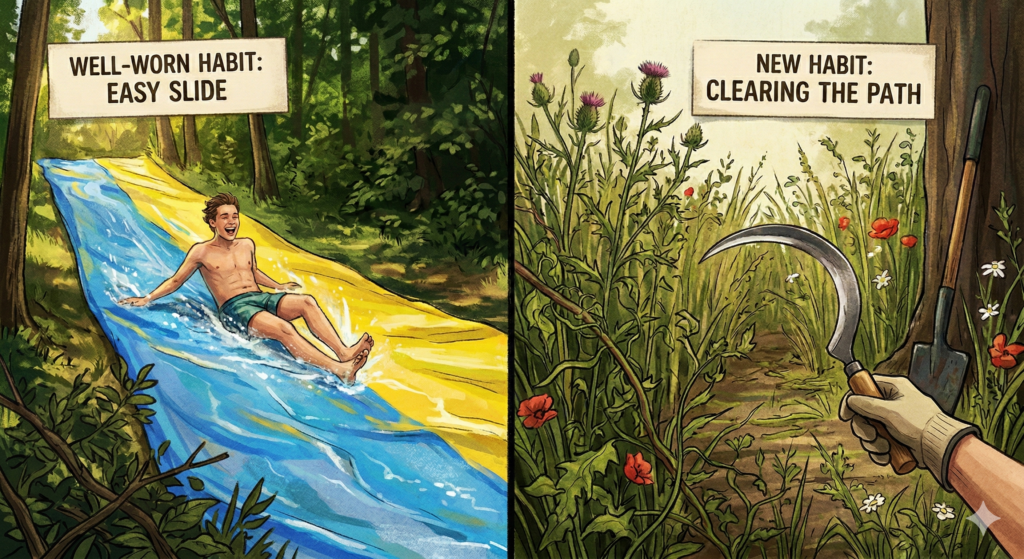
Think of a well-worn habit as a slip-and-slide. Once it’s grooved in, you just glide. You don’t decide to do it. You don’t think about it. You’re already at the bottom.
Now think about a new habit you’re trying to build. That slip-and-slide? It’s hidden deep in a wooded forest. To even find it, you have to cut down trees, clear the brush, and do a lot of work just to reveal the path — let alone make it smooth.
Meanwhile, the old habit is right there. Wide open. Easy as ever.
That’s not a character flaw. That’s neuroscience. Well-practiced behaviors are fast, automatic, and low-effort. New ones require attention, intention, and a whole lot of repetition before they start to feel anywhere close to natural.
Does It Really Take 30 Days to Form a Habit?
The “30-day rule” sounds reassuring — but it’s not really accurate. Research shows that habit formation takes anywhere from 18 to 254 days, with an average closer to 66. And it varies significantly depending on the behavior, the person, and the context.
The problem with the 30-day myth is that when someone doesn’t feel automatic at day 31, they assume they’ve failed. They haven’t. They’re just still in the forest, still clearing.
The more useful message: consistency over time matters far more than hitting any specific number.
5 Things That Actually Improve Your Odds of Sticking With a New Behavior
- Make micro moves. Don’t overhaul your life. Break the behavior into the smallest possible version of itself. The goal is to make it so small that skipping it feels harder than doing it. Five minutes beats zero every time.
- Habit stack onto something automatic. Attach a new behavior to something that already happens every day without thought — your morning coffee, brushing your teeth, your commute. “While I drink my coffee, I will…” is a far more reliable setup than building a habit in a vacuum.
- Track what you’re doing. Monitoring behavior is one of the most powerful change tools we have — and it’s underused. Just the act of noticing, without judgment, starts to shift things. Paper, app, journal — whatever reduces friction. Test and learn.
- Connect your habit to something that matters to you. “I want to manage stress so I can be present for my family” is a more durable motivator than “I want to avoid a bad outcome.” Fear gets you started. Values keep you going.
- Find your people. Accountability is one of the strongest predictors of behavior change success. A partner, a group, a therapist — someone who knows what you’re working on and can help you keep clearing trees.
What to Do When You Slide Back Down
You will. At some point, you’ll find yourself back at the bottom of the old slip-and-slide, wondering how you got there again.
This is where most people quit — not because of the slip itself, but because of the story they tell themselves about it. “I knew I couldn’t do this.” “I have no discipline.” “What’s the point.”
That story is called the abstinence violation effect, and it’s one of the most well-documented predictors of full relapse. The slip is small. The interpretation is what takes you all the way back.
A more useful response: welcome it. Not with enthusiasm — just with honesty. Yup, I slid. Okay. Now I start clearing trees again.
The people who succeed at behavior change aren’t the ones who never slip. They’re the ones who return to the forest faster, and with a little more self-compassion than last time.
When to Get Support
If you’ve been trying to change something on your own and keep running into the same wall, that’s not a sign to try harder. It’s a sign to try differently.
Approaches like Cognitive Behavioral Therapy (CBT) and Motivational Interviewing (MI) were built specifically for this work. They help you understand the thoughts and patterns driving your behavior, connect change to what actually matters to you, and develop strategies that hold up when real life — which is messy, and unpredictable, and sometimes exhausting — happens.
They also help you get better at the part most people skip: what to do when you slide. Which, it turns out, is the whole game.
At the CBT Center, this is the work we do every day. If you’re in New Jersey or one of the 40+ states we serve through PSYPact, we’d love to connect. You can learn more about our approach to individual therapy at cbtcenter.org/services/individual-therapy.
Frequently Asked Questions About Habit Formation
Why do old habits feel so effortless compared to new ones?
Because they’re deeply grooved. The more you’ve done something, the more automatic it becomes — your brain optimizes for efficiency. A new behavior is still being carved out. It takes real cognitive effort until repetition starts to wear the path smooth.
Is it normal to slip multiple times before a new habit sticks?
Completely. Most lasting behavior change is preceded by several attempts. Setbacks are built into the process — they’re not proof it isn’t working. They’re proof you’re in it.
What if I’ve been trying to change the same thing for years?
Then it’s probably time to get some support. Long-standing patterns, especially ones tied to anxiety, avoidance, or emotional coping, often need more than willpower and a good app. That’s not failure. That’s just knowing when to bring in better tools.
The Bottom Line
Old habits have a beautiful, well-worn slide. New habits are in the forest.
Your job isn’t to be perfect. It’s to keep showing up with a sickle.
Small, consistent, values-connected effort. Tracked. Supported. And when you slide back — because you will — you note it, you welcome it, and you start clearing again.
The path gets easier the more you clear it. That’s not motivation. That’s just how brains work.
— About the Author —
Dr. Michelle Drapkin, PhD, ABPP, A-CBT is a board-certified clinical psychologist and founder of The CBT Center in Highland Park, NJ. She is the author of The Motivational Interviewing Path to Personal Change, a national speaker, and a MINT-certified MI trainer. The CBT Center serves patients across New Jersey and 40+ states via PSYPact. Learn more at cbtcenter.org.